The Beast Beneath the Coil: An In-Depth Review of the Minelab Manticore
Some detectors find metal. Others reveal history.

There are moments in every treasure hunter’s life that feel like turning the page to a new chapter.
Finding your first silver coin.
Recovering a relic that has been buried since the Revolutionary War.
Taking your first breath underwater while descending toward a centuries-old shipwreck.
And then there are moments that seem far less dramatic at first, like opening a cardboard box sitting on your front porch.
Inside that box was my Minelab Manticore.
If you’ve spent any amount of time around the metal detecting community, you’ve probably heard people talk about the Manticore with a mixture of admiration and intimidation. Some call it one of the most advanced detectors Minelab has ever produced. Others say it’s unnecessarily complicated. Some swear it’s worth every penny, while others insist that machines costing considerably less can find just as much treasure.
Like most debates in this hobby, the truth lives somewhere in the middle.
Before buying the Manticore, I spent countless hours researching detectors. I watched experienced relic hunters, beach hunters, and coin shooters put flagship machines through their paces. I compared the Manticore against the XP Deus II, Nokta Legend, Minelab Equinox series, and nearly every premium detector that caught my attention.
Everyone seemed to have an opinion about the perfect machine.
The funny thing about treasure hunting is that there really isn’t one.
There is only the right tool for the explorer holding it.
Still, something about the Manticore kept pulling me back. Maybe it was Multi-IQ+. Maybe it was the two-dimensional Target Trace display. Maybe it was simply curiosity.
Whatever the reason, I eventually stopped watching other people review it and decided to make up my own mind the old-fashioned way.
By taking it into the field.
My First Hunt, and My First Humbling Lesson
I wish I could tell you my first outing with the Manticore was legendary.
That I marched into my backyard, swung the coil a few times, and unearthed a cache of Spanish silver while dramatic music played somewhere in the distance.
That isn’t what happened.
Instead, I turned the detector on…
And it sounded like the entire yard was made of metal.
Bloops. Beeps. Chirps. High tones. Low tones.
Target IDs bounced across the screen like popcorn in a microwave.
For a brief moment, I honestly wondered whether the detector was malfunctioning.
It wasn’t.
My backyard really is that full of iron.
Years of farming, construction, discarded hardware, square nails, modern trash, old tools, and who knows what else have turned the ground into an obstacle course for any detector.
My old X-Terra Pro had already found some wonderful things there, including a crotal bell, wheat pennies, old suspender clips, buttons, and other relics that reminded me history often hides in the most ordinary places.
But the Manticore began showing me just how much information was still hiding beneath all that iron.
At first, it was overwhelming.
Eventually, I realized that information was its greatest strength.
This Isn’t a Detector That Holds Your Hand
One of the easiest mistakes a new Manticore owner can make is assuming more expensive automatically means easier.
It doesn’t.
If anything, the opposite can be true.
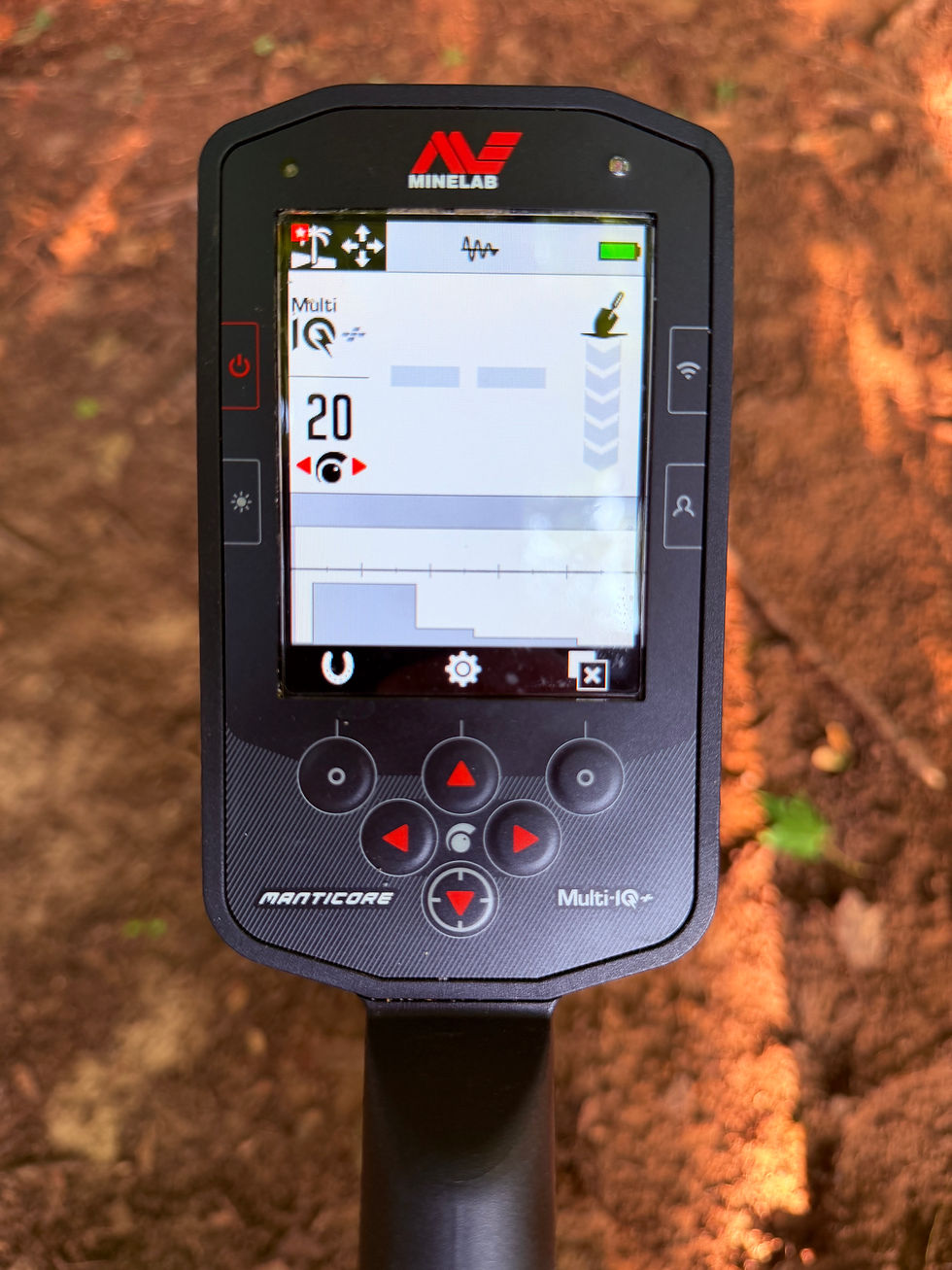
The Manticore is unapologetically information-rich.
Think of it like moving from a basic dashboard into the cockpit of a modern aircraft. Both machines may get you where you’re going, but one gives you considerably more information along the way.
Target identification becomes only part of the picture.
Audio carries more nuance.
The two-dimensional Target Trace adds another layer of interpretation.
Recovery speed, ferrous limits, audio profiles, sensitivity, search modes, and other adjustments allow the detector to be shaped around both the ground and the person swinging it.
That capability comes with responsibility.
The Manticore doesn’t make every decision for you.
It gives you clues.
You still have to solve the mystery.
And that is exactly what I enjoy about it.
Treasure hunting has always been an exercise in interpreting evidence. The Manticore simply puts more of that evidence in front of you.
Built Like an Explorer’s Tool
Before you even swing the Manticore, one of the first things you notice is how refined it feels.
The carbon-fiber shaft is lightweight and rigid, while the collapsible design makes transportation easy whether you’re loading it into the vehicle before sunrise or packing for a weekend at the beach.
At just under three pounds, the Manticore is surprisingly comfortable considering the technology packed into it.
Is it as featherweight as the XP Deus II?
No. The Deus II still has an advantage there.
But compared with older flagship detectors, especially something like the CTX 3030, the Manticore feels positively athletic.
That matters more than specifications on a website might suggest.
Spend six hours walking a colonial field or several miles following the wet sand after a coastal storm and every ounce eventually introduces itself.
Comfort isn’t a luxury during a long hunt.
It is part of performance.
A Screen That Actually Earns Its Place
A lot of detector screens simply confirm what your ears are already telling you.
The Manticore’s display becomes part of the hunt itself.
The bright color screen is easy to read outdoors, something that becomes particularly important on an open beach where sunlight is reflecting off wet sand.
The menus are logically arranged once you become familiar with them. There is certainly a learning curve, but the complexity comes from the number of options available rather than poor design.
There are also smaller features that begin making sense once you use them in the field.
The built-in flashlight initially struck me as something I might never need.
Then I found myself finishing hunts at dusk.
Suddenly, it made perfect sense.
Vibration is another feature that sounds minor until you’re detecting beside crashing surf or in heavy wind. In conditions where audio becomes harder to hear, that extra tactile feedback is genuinely useful.
Those little touches matter because they make the detector feel like something designed to be used outdoors, not simply admired on a specification sheet.
The Heart of the Machine: Understanding Multi-IQ+
If you’ve looked at Minelab’s marketing, you’ve probably seen the words “Multi-IQ+” more than a few times.
Marketing departments love impressive names.
This one actually matters.
To understand why, imagine trying to identify someone standing at the end of a dark street.
Shine a flashlight from one direction and you might recognize the outline.
Add light from several different angles and suddenly you start seeing details that were previously hidden.
That’s a simplified way to think about simultaneous multifrequency detection.
Traditional single-frequency machines operate using one frequency at a time. Different frequencies can have different strengths. Some may respond particularly well to certain low conductors, while others can be useful when chasing high-conductive targets or dealing with particular ground conditions.
Simultaneous multifrequency systems approach the problem differently.
Rather than forcing the detectorist to choose a single frequency for every target beneath the coil, the detector analyzes information across multiple frequencies at once.
That gives it more information to work with.
Does this mean the Manticore magically sees treasure that no other machine can detect?
No.
Depth still depends on soil conditions, mineralization, moisture, target orientation, target size, nearby iron, coil choice, settings, and several other variables.
Physics hasn’t changed.
What has changed is the amount of information available to the detector before you decide whether to dig.
That distinction matters.
In my experience, one of the Manticore’s greatest strengths isn’t simply the pursuit of additional depth.
It is helping me make more informed decisions about the signals already beneath my coil.
Across hundreds or thousands of targets, those decisions add up.
The Feature That Changes Everything: 2D Target Trace
If the Manticore has a signature feature, this is probably it.
At first glance, Target Trace can look intimidating.
Colored marks. Moving responses. Ferrous information. Conductive information.
It almost resembles radar.
My first reaction was basically:
What on earth am I looking at?
The answer turned out to be one of my favorite features on the detector.
Most detectors present target identification primarily as a number.
A particular coin might produce one range of IDs.
A pull tab might produce another.
Simple enough.
The Manticore allows you to go further by watching how the target behaves across its two-dimensional display.
A clean target may produce a relatively tight, consistent response.
Certain iron objects and bottle caps can present differently.
Targets sitting near iron may reveal information that a single number alone cannot fully communicate.
The more time you spend watching the screen while listening to the audio, the more you begin recognizing patterns rather than simply memorizing numbers.
That changes the question.
Instead of asking only:
“What Target ID did I get?”
You begin asking:
“What is this target trying to tell me?”
That is where the Manticore starts becoming something more interesting than a detector with a fancy screen.
It becomes a tool for interpretation.
Where Legends Are Found: Putting the Manticore to the Test
There comes a point where every review has to stop talking and start digging.
Specifications are useful. Marketing brochures are filled with promises. Every flagship detector seems to promise more depth, faster recovery, better separation, and enough technology to make buried treasure practically wave from beneath the soil.
But treasure has never cared about advertisements.
History doesn’t care what your detector costs.
The real test happens when the coil passes over something that has been waiting underground for one hundred, two hundred, perhaps even three hundred years.
That is where reputations are made.
The Backyard That Refused to Give Up Its Secrets
If there is one place that has taught me more about the Manticore than anywhere else, it is my own backyard.
Most people would probably consider it a terrible place to test a premium detector.
Iron everywhere.
Square nails.
Modern trash.
Old wire.
Fragments of rusted metal.
Targets stacked beside and sometimes practically on top of one another.
To a beginner, it can feel impossible.
To a capable detector, it becomes a puzzle.
One of the biggest surprises wasn’t simply how many signals the Manticore produced. It was how those signals began separating themselves once I slowed down and actually listened.
During my earliest hunts, every chirp seemed important.
Eventually, I rediscovered something experienced detectorists have understood for generations.
Not every signal deserves a hole.
Learning why is where things get interesting.
Learning to Slow Down
One mistake many detectorists make with a new machine is trying to cover too much ground too quickly.
I did it too.
Coming from a simpler detector, I was used to thinking in terms of acreage.
The Manticore encouraged me to think in terms of information.
When I slowed my sweep, questionable signals became easier to investigate from multiple directions. Iron falses became easier to recognize. Short high tones hiding among nails became easier to isolate.
I stopped worrying about hunting faster.
I started worrying about hunting better.
That change probably improved my results more than chasing any mythical perfect setting ever could.
Iron Isn’t the Enemy
Most detectorists hate iron.
I understand why.
Rusty nails can masquerade as desirable targets.
Large pieces of iron can fool even experienced hunters.
Bottle caps have probably caused more small moments of heartbreak than anyone cares to admit.
But old iron can also tell you something important.
People were here.
Old iron often means old activity, and old activity means human beings worked, lived, traveled, repaired things, ate meals, built structures, and occasionally lost whatever happened to be in their pockets.
Colonial cellar holes.
Old farmsteads.
Forgotten homesites.
Military encampments.
Many great relic sites are filled with iron.
The goal isn’t always to escape it.
Sometimes the goal is learning how to hear through it.
That is an environment where the Manticore earns its keep.
Recovery Speed Where It Matters
Recovery speed is one of those terms that sounds far less exciting than it is.
In practical terms, it influences how quickly the detector can respond to closely spaced targets.
Imagine a desirable target sitting beside a square nail.
A detector that blends those responses together may never give you enough reason to stop.
A fast, properly configured machine has a better chance of letting the individual targets reveal themselves.
In iron-heavy environments, that matters enormously.
I began stopping over signals that might previously have blended into the background.
Sometimes they were junk.
Sometimes they were worth investigating.
Those are odds I’m happy to take.
The Beach, Where Multi-IQ+ Feels at Home
If old fields are where relic hunters earn their patience, beaches are where many detectorists fall in love with the hobby.
There is something almost therapeutic about walking the shoreline before sunrise.
The crowds haven’t arrived.
The gulls are already arguing over breakfast.
The tide has rewritten the landscape overnight.
Every wave has moved something.
Maybe sand.
Maybe trash.
Maybe a ring someone thought was gone forever.
Saltwater beaches are also demanding environments for metal detectors. Wet salt can create conditions that make some machines unstable, noisy, or difficult to interpret.
This is one of the environments where the Manticore feels remarkably composed.
Using its beach modes, I have found it capable of remaining stable while still providing the kind of information I want from the ground beneath me.
Is it perfectly silent?
No.
Nor do I necessarily want it to be.
The goal isn’t silence.
The goal is useful information.
Tiny Gold and Big Expectations
One of the things that interested me about the Manticore early on was its sensitivity to smaller conductors.
Tiny jewelry, small earrings, delicate gold, and other low-conductive targets can be challenging.
Detectorists love dreaming about silver dollars and buried caches, but on a modern beach, gold jewelry is often the treasure most of us are realistically chasing.
Those signals are not always loud and obvious.
Sometimes they are subtle.
The Manticore gives you the tools to investigate those subtleties rather than immediately dismiss them.
Of course, there is a tradeoff.
The more willing you are to investigate low conductors, the more aluminum you may become intimately acquainted with.
Nobody said treasure hunting was fair.
Freshwater Adventures
Freshwater detecting occupies an interesting middle ground.
You lose some of the challenges created by saltwater, but you gain decades of accumulated human activity.
Swimming holes.
Boat launches.
Fishing docks.
Campgrounds.
Beaches.
Old recreation areas.
Each can hold an astonishing amount of history.
The Manticore transitions naturally from land to shallow water, which is one of the reasons I appreciate its versatility.
Adventure doesn’t always require an ocean.
Sometimes it is sitting beneath a quiet New England lake.
What About Diving?
This is an important distinction for anyone interested in underwater treasure hunting.
Can the Manticore go underwater?
Absolutely.
But there is a difference between an underwater-capable detector and a detector chosen specifically for deeper scuba work.
The Manticore is rated for submersion to roughly sixteen feet, making it extremely useful for wading, snorkeling, shallow-water detecting, river work, and nearshore exploration.
If your goal is spending hours working a wreck or site thirty or forty feet underwater, however, you should choose equipment designed for that environment.
Machines such as the XP Deus II, properly configured for underwater use, or dedicated dive detectors become more appropriate for those missions.
And that is perfectly fine.
No detector should be expected to dominate every environment.
Good explorers choose the tool that matches the expedition.
Does It Actually Find More Treasure?
This is probably the hardest question to answer honestly.
Because the answer isn’t simply yes or no.
The Manticore does not create treasure where none exists.
It does not transform pull tabs into Spanish reales.
It will not make every deep whisper turn into a gold coin.
What it does exceptionally well is reduce uncertainty.
It gives me more ways to investigate a signal before deciding what to do with it.
Audio.
Target ID.
Target Trace.
Sweep direction.
Ferrous behavior.
Repeatability.
Instead of asking only:
“Should I dig this?”
I find myself asking:
“What is the detector telling me?”
That changes the experience.
Better information can lead to better decisions, and better decisions can eventually lead to better finds.
Not because the detector performed magic.
Because the person holding it became more informed.
Somewhere along the way, that was when the Manticore really clicked for me.
I wasn’t simply learning settings anymore.
I was learning how the machine communicated.
And the better I understood it, the more useful the information became.
The Manticore wasn’t making treasure hunting easier.
It was making it deeper.
Not necessarily deeper in inches.
Deeper in understanding.
For someone who chases history as much as metal, that may be the more important measurement anyway.
Choosing Your Expedition Partner
This brings us to the inevitable question.
How does the Manticore compare with the other serious detectors competing for space in your truck, backpack, or gear closet?
This is where I want to make an important distinction.
I have personally spent significant time with the Manticore and came to it after using the X-Terra Pro. I have not spent hundreds of field hours using every detector discussed below.
So I am not going to pretend otherwise.
My observations about the Manticore come from firsthand use. When discussing competitors such as the XP Deus II, Nokta Legend, Equinox 900, and CTX 3030, I am drawing on their published capabilities and the experiences widely reported by people who use them.
That is an important difference.
A good review should help you make a decision, not pretend the writer has experience they don’t actually have.
There is no universal champion here.
These machines simply approach the hunt differently.
Minelab Manticore: The Detective
If I had to give the Manticore a personality, it would be the detective.
Everything about it encourages investigation.
It doesn’t merely announce that something metallic is beneath the coil.
It starts handing you clues.
Here is the Target ID.
Here is its position on the two-dimensional display.
Listen to the audio.
Sweep from another direction.
Watch the response.
Consider the iron surrounding it.
Then make your decision.
That philosophy is what I enjoy most.
The machine doesn’t replace your judgment.
It sharpens it.
The tradeoff is that the Manticore asks more from the operator than simpler detectors.
If you want to turn it on and instantly understand every piece of information being thrown your way, those first few hunts may be frustrating.
Give it time, however, and the complexity begins feeling less like clutter and more like a conversation.
XP Deus II: The Athlete
If the Manticore is the detective, the Deus II might be the athlete.
Its reputation has been built around speed, low weight, modularity, and serious capability across a wide range of hunting environments.
The extremely light configuration is especially attractive during long relic hunts where fatigue can eventually affect both concentration and swing technique.
Its wireless architecture also gives the Deus II a very different personality from the Manticore.
For underwater hunters, there is another major distinction. When properly configured for underwater detecting, the Deus II can operate considerably deeper than the Manticore, making it far more appealing for someone whose adventures include actual scuba diving rather than primarily wading and shallow-water work.
For my own style of hunting, I still prefer the Manticore’s visual approach to target analysis.
But if I were adding another premium detector specifically for extremely long relic hunts or deeper underwater exploration, the Deus II would absolutely deserve consideration.
Nokta Legend: The Practical Adventurer
Every expedition needs someone who understands value.
That is where the Nokta Legend made its mark.
It brought simultaneous multifrequency technology, waterproof construction, strong adjustability, and a serious feature set into a price range that made a lot of detectorists stop and pay attention.
That remains its greatest strength.
The Legend is not trying to win a luxury contest.
It is trying to give treasure hunters an enormous amount of capability without requiring flagship money.
For someone who wants to hunt beaches one weekend, parks after work, and an old farm field the next without emptying the savings account, it is difficult to ignore.
Sometimes the smartest expedition isn’t the one carrying the most expensive equipment.
It is the one that still has money left for gas.
Minelab Equinox 900: The Trusted Guide
The Equinox series has earned something arguably more valuable than hype.
Trust.
The Equinox 900 carries forward the versatility that made the Equinox platform so successful while offering a lighter, more streamlined experience than some older premium detectors.
For a detectorist who wants excellent all-around performance but doesn’t necessarily need the Manticore’s two-dimensional visualization and extra layers of target analysis, the Equinox 900 remains an extremely compelling option.
That is probably the easiest way to describe the difference.
The Manticore gives me more information to investigate.
The Equinox gives the hunter a more straightforward route to excellent performance.
Think of the Manticore as a cockpit full of instruments.
The Equinox is the trusted four-wheel-drive vehicle that starts every morning and gets you deep into the country.
Neither approach is inherently better.
It depends on the person making the trip.
CTX 3030: The Veteran Explorer
Then there is the old veteran.
The CTX 3030 has been around long enough that newer detectorists sometimes assume its age automatically makes it irrelevant.
That would be a mistake.
Yes, it is considerably heavier than modern flagships.
Yes, detector technology and ergonomics have moved forward.
But the CTX earned its reputation for a reason.
Its target analysis, ferrous and conductive information, GPS functionality, and long history among serious coin hunters continue to give it a devoted following.
Would it be my first recommendation to someone entering the premium detector market today?
Probably not.
Would I underestimate an experienced CTX user walking into an old park looking for deep silver?
Not for a second.
An old explorer carrying a weathered map can still know exactly where the treasure is buried.
So Which One Would I Choose?
After all the specifications, comparisons, forum debates, videos, and opinions, I would still choose the Manticore.
Not because I believe it is objectively the best detector ever made.
I don’t.
I choose it because it matches the way I like to hunt.
I enjoy slowing down.
I enjoy investigating questionable signals.
I enjoy trying to understand what is happening beneath the coil before I put a shovel into the ground.
The Manticore rewards that curiosity.
Could I find treasure with a Deus II?
Of course.
A Legend?
Absolutely.
An Equinox 900?
Without question.
The logo on the control box does not create treasure.
Research, patience, access, experience, and a willingness to investigate the right signals still matter enormously.
The detector simply helps you hear the whispers beneath your feet.
Field Notes
Biggest Surprise
The Manticore’s greatest strength, for me, isn’t raw depth.
It’s confidence.
Having several forms of target information available at once has changed how I evaluate questionable signals.
Hardest Lesson
More information does not automatically make detecting easier.
During my first few hunts, I sometimes felt overwhelmed.
Now I understand why the machine was giving me so much to work with.
One Thing I’d Tell Every New Owner
Don’t spend your first month obsessing over the perfect settings.
Learn the detector first.
Experiment. Listen. Watch the screen. Dig enough questionable targets to discover when you were right and when you were spectacularly wrong.
The settings matter.
Your understanding matters more.
Who Is the Manticore Really For?
By now, you may have noticed that I have spent very little time declaring the Minelab Manticore the best detector ever built.
That wasn’t an accident.
Treasure hunting has a funny way of humbling people who speak in absolutes.
Spend enough weekends in this hobby and eventually you’ll watch someone carrying a detector half the price of yours recover something remarkable while you’re still deciding whether your latest signal deserves a hole.
That is part of what makes treasure hunting fascinating.
Technology matters.
But it isn’t everything.
Research matters.
Patience matters.
Permission matters.
Knowing your machine matters.
The detector is one part of the equation.
So rather than asking whether the Manticore is the best, I think there is a much more useful question.
Who is it actually for?
The Hunter Who Loves Solving Mysteries
Some detectorists want simplicity.
Turn it on.
Choose a mode.
Start swinging.
There is nothing wrong with that.
The Manticore takes a different approach.
It seems to assume the person holding it is curious.
It rewards the detectorist who stops over an uncertain signal instead of immediately moving on.
It rewards experimentation.
It rewards time spent learning what happens when a target is approached from another direction, when iron is nearby, or when the audio doesn’t quite match what the screen seems to be saying.
If that sounds exhausting, the Manticore may be more detector than you actually need.
If that sounds fun, you are probably exactly the person it was built for.
Who Should Think Twice
This may surprise some people, but I don’t necessarily think the Manticore is the best first detector for everyone.
Could a beginner learn on it?
Absolutely.
There is no rule saying you must graduate through cheaper machines before touching a flagship.
But there is also value in learning the fundamentals on something simpler.
A beginner starting with the Manticore should understand that buying more capability also means accepting a steeper learning curve.
You can absolutely grow into the machine.
Just don’t expect the price tag to eliminate the need for practice.
The Manticore asks for commitment.
In return, it gives you room to grow for a very long time.
Who Will Absolutely Love It
If your idea of a perfect Saturday involves wandering through an old field wondering who stood there two centuries ago, this detector will probably make sense to you.
If you enjoy combing beaches after coastal storms, investigating old homesites, exploring forgotten roads, or trying to separate one faint nonferrous signal from a bed of square nails, the Manticore is very much in its element.
More than anything, I think it suits detectorists who enjoy the hunt as much as the find.
Maybe even more.
The Accessories I’d Actually Buy
Metal detecting has an impressive ability to convince us we need more equipment.
New coils.
New headphones.
New gadgets.
New bags to carry the new gadgets.
Some of it is useful.
Some of it eventually ends up collecting dust.
If I were starting over with the Manticore, I would prioritize a few basics.
Good headphones matter because subtle audio matters. Tiny variations in a signal can sometimes tell you more than repeatedly staring at a number on the screen.
A quality pinpointer is another essential. Every minute spent fumbling around inside a hole is a minute the search coil isn’t passing over the next target.
And then there is the humble finds pouch.
Not glamorous.
Not exciting.
Absolutely necessary.
Beyond the basics, however, I would invest in experience before accessories.
Put serious hours on the stock machine before deciding what supposedly needs upgrading.
You may discover the most useful accessory is simply time.
What I Would Like to See Improved
No detector is perfect.
The Manticore isn’t either.
One area I would love to see Minelab continue developing is education for new owners.
The detector is incredibly capable, but that capability can be intimidating. More advanced learning material showing exactly how Target Trace, ferrous limits, audio, recovery settings, and different hunting environments interact would shorten the learning curve for a lot of people.
I also hope Minelab continues expanding and refining the Manticore ecosystem over time.
Modern detectors have an advantage their predecessors never really had. Software can continue improving long after the machine leaves the factory.
That gives manufacturers an opportunity to keep refining an already capable platform.
I hope Minelab takes full advantage of it.
A Detector Doesn’t Find Treasure
There is one thing I wish every new detectorist understood.
The detector is not the treasure hunter.
You are.
The detector provides information.
Everything else comes down to the person holding it.
The nights spent studying old maps.
The research that uncovers a forgotten homesite.
The courage to knock on someone’s door and politely ask permission.
The willingness to return after rain changes the soil.
The patience to investigate one more faint signal when everyone else has decided the site is hunted out.
Those things find treasure.
The machine helps.
And in my experience, the Manticore helps exceptionally well.
The Explorer’s Verdict
After spending real time learning the Manticore in trash-filled ground, iron-heavy sites, beaches, and the ordinary places where history so often hides, I have come to appreciate something about this detector.
It may not impress you immediately.
In fact, during those first few hunts, it might do the opposite.
It may frustrate you.
It may confuse you.
It might even make you wonder whether you just made a very expensive mistake.
Stick with it.
Because somewhere along the way, something changes.
The audio begins making more sense.
Target Trace stops looking like random marks on a screen.
Patterns start replacing guesswork.
Signals that once seemed chaotic begin revealing small details.
The detector hasn’t changed.
You have.
That is the moment the Manticore becomes more than another piece of equipment.
It becomes a partner in the hunt.
Not one that makes decisions for you.
One that quietly places the clues on the table and leaves the final decision in your hands.
Maybe that is why I enjoy it as much as I do.
Treasure hunting has never really been about digging metal.
It is about questions.
Who walked here?
What happened here?
What was lost?
Who thought they would come back for it?
Every signal is a tiny mystery beneath the ground.
The Manticore cannot promise that the next one will be a Spanish reale, an old button, or a gold ring that slipped from someone’s hand decades ago.
No detector can.
What it can do is give you an extraordinary amount of information before your shovel ever breaks the soil.
For the kind of treasure hunter who enjoys solving the mystery as much as recovering the prize, that is a powerful thing.
History has spent centuries hiding its secrets.
The joy isn’t simply in finding them.
The joy is in the chase.
And with the Manticore in your hands, every swing of the coil feels like another page waiting to be written in your own adventure.


Comments